
Saints we honour in our prayer
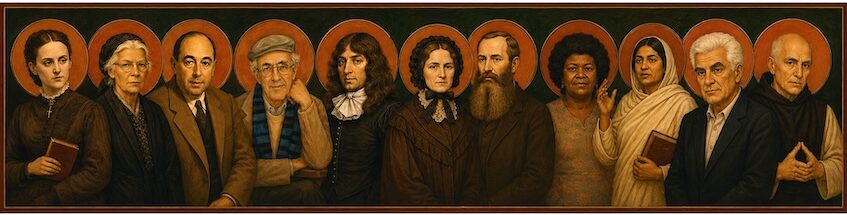
Each week in our Sunday liturgy, our prayers name a company of “faithful servants of every time and place — mothers and fathers in the faith who inspire us, guide us and encourage us.” This page exists so that anyone curious about a name spoken in that prayer can go a little deeper — to find out who these people were, what they did, and why we still think their lives are worth remembering out loud, together, in worship.
Honouring our forebears matters not because they were flawless — several of the people on this page plainly were not, and we’ve tried to say so honestly rather than tidy them up — but because a community that forgets where its convictions came from loses the ability to test whether it’s still living up to them. Naming the saints keeps us honest about our own history and grateful for a much wider inheritance than we could have built alone.
As Baptists, we hold this practice a little differently than some other traditions do. We don’t pray to the saints, asking them to carry our petitions to God on our behalf. But we do believe we pray with them — and there are moments in our liturgy where we call on them to pray with us, inviting their voices into ours rather than routing our prayers through theirs. Following the theology set out by Paul Fiddes, Brian Haymes, and Richard Kidd in Baptists and the Communion of Saints (Waco: Baylor University Press, 2014), we understand this communion as possible only because all of us, living and dead, are held together within the same covenant relationship with the triune God. It isn’t a network of saints we pray to; it’s a fellowship we belong to, alongside them, because God has bound us all into it. Remembering them each week, and sometimes asking them to join their prayers to ours, is less like addressing the departed and more like turning to the rest of a very large family gathered around the same table.
Groups
Each Sunday, we remember one of seven different groups of saints, and so we have grouped them here in the same way. The groups are:
- those who pioneered new pathways of witness and discipleship;
- those who paid the ultimate price for following in the footsteps of Jesus;
- those who left us spiritual writings which continue to inspire faith and hope;
- those who taught us to unite the quest for justice with the life of prayer;
- those whose insights helped us see new light and truth breaking forth from God’s Word;
- those whose courageous leadership opened our eyes to see Christ among the outcasts and victims; and
- Indigenous leaders who have shown us all the way of Jesus.
Those who pioneered new pathways of witness and discipleship
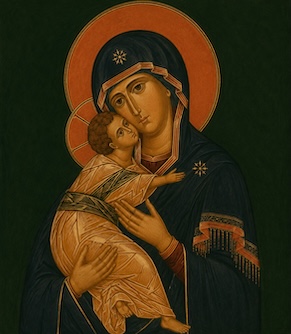
Holy Mary, the God-bearer (1st century BC – 1st century AD)
Before anyone preached the gospel, someone had to bear it — literally. Mary’s yes to Gabriel was not passive acquiescence but active, costly consent to carry God into the world at the cost of her reputation, her safety, and eventually the sight of her son’s execution. She is present at every hinge of the story: at the wedding in Cana pressing him toward his first sign, at the foot of the cross when the male disciples had fled, and in the upper room with the gathered disciples awaiting the Spirit at Pentecost — present, that is, at the very birth of the church, not merely at the birth of Christ. The title Theotokos, God-bearer, affirmed at the Council of Ephesus in 431, was as much a statement about the nature of Christ as about Mary, but it named her as the first and paradigm disciple: the one who heard the word of God and did it before anyone else had the chance.

Mary of Magdala (1st century AD)
Long before she became the first witness to the resurrection, Mary of Magdala pioneered something quieter but just as unprecedented: she was one of the women who followed Jesus from Galilee and financially supported his itinerant ministry out of her own means (Luke names her first among them). That itself broke the pattern of who counted as a disciple. She stayed at the cross when most of the twelve did not, and went to the tomb to complete the burial rites when it seemed the story was over. Whatever her life had been before Jesus freed her from what Luke calls seven demons, she modelled a discipleship measured not by status or credential but by simple, costly presence — showing up, staying, and returning, again and again, when it would have been easier to go home.
Later legend gave her an unexpected emblem: an egg. Eastern Christian tradition tells of Mary travelling all the way to Rome and gaining an audience with the Emperor Tiberius, to whom she announced simply, “Christ is risen.” When Tiberius scoffed that this was as likely as the egg on the table before them turning red, the egg is said to have turned red on the spot. The story is almost certainly a later invention — but it preserves something true to her character as we meet her in the Gospels: someone who, having once seen and said the thing that mattered most, could not be talked out of saying it again, even to an emperor, even when believed by no one.
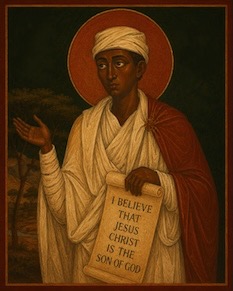
Bakos of Ethiopia (1st century AD)
Though not named in Acts 8:26-40 where his story is told, the Ethiopian eunuch is remembered by the name Bakos in the Ethiopian Orthodox Tewahedo Church, which has claimed him as a founding figure ever since. A senior court official — treasurer to the Candace, the dynastic title of the queens of Kush (the Nubian kingdom the Greeks called “Ethiopia,” roughly modern Sudan, distinct from the Ethiopia we know today) — Bakos was, in the plainest sense of the word his own culture used for him, a eunuch: castrated, and understood in the ancient world as belonging to a distinct sexual and social minority, neither fully man nor woman, barred by Deuteronomy’s purity code from ever joining “the assembly of the Lord” (Deuteronomy 23:1). It’s become common to soften this — to talk about him as a foreign official or a religious outsider and let the word “eunuch” pass by as incidental detail. It wasn’t incidental. His body, and what his body meant in his own time’s categories of gender and sex, is precisely why Isaiah’s prophecy of eunuchs given “a monument and a name better than sons and daughters” (56:3–5) mattered enough that he read it, and precisely why his baptism reads as such a direct answer to it. Returning from Jerusalem — where he had gone to worship despite the law that shut him out — reading that same suffering-servant song from Isaiah, he met Philip on the desert road to Gaza, and asked what was to stop him being baptised. Philip, recognising that it was the Holy Spirit who was overturning the old rules here, baptised him on the spot. Someone whose very body the law had excluded became one of the first people baptised in the whole book of Acts, sexually and socially ‘other’ by every category his world had, and welcomed anyway, without qualification, without being asked to become anything other than what he already was. Writing within a century of the event, Irenaeus of Lyons recorded that this man carried the gospel home and preached it among his own people. Whether the mission happened exactly as Irenaeus describes we can’t be certain, but an excluded man becoming the one who carries the good news home, rather than waiting for it to be carried to him, is a tradition worth keeping regardless of how much of the detail is legend.
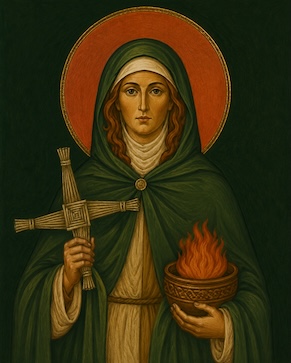
Brigid of Kildare (c. 451–525)
Brigid founded and led a double monastery at Kildare — monks and nuns together, under her own authority as abbess, with a bishop she herself is said to have chosen serving alongside her. That alone was a genuinely new pathway: a woman exercising a scale of ecclesial authority almost unheard of for the era. The stories that cluster around her — the cloak that spread to cover an impossibly large field, the bathwater turned to beer for visiting clergy, the relentless, almost compulsive generosity to the poor that reportedly worried her father — read as legend, but they preserve something true about her: a Christianity thoroughly at home in Irish soil, unembarrassed by hospitality and abundance, holding contemplative and practical life together without apology.
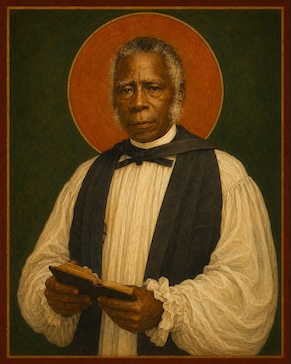
Samuel Ajayi Crowther (c.1807–1891)
Crowther was born Ajayi in Osogun, Yorubaland, Nigeria. At about thirteen he was taken in a slave raid, sold and resold several times, and put aboard a Portuguese slave ship bound for the Americas — intercepted by a British anti-slavery patrol in 1822 and diverted instead to Sierra Leone, where he was freed. There he was educated, converted, baptised into an English name he kept for the rest of his life, and became one of the first students at the Church Missionary Society’s new Fourah Bay Institute. He distinguished himself on the 1841 Niger expedition, was sent to England for ordination in 1843, and went on to produce the first grammar and vocabulary of the Yoruba language written by a native speaker, followed by a Yoruba translation of the Bible and the Book of Common Prayer — scholarly work as significant as anything he did in a pulpit. In 1864, when the CMS finally moved to establish an African-led diocese along the Niger, Crowther was consecrated its bishop: the first African bishop in the Anglican Communion, leading an entirely African mission staff by design. It should have been the vindication of everything he’d built. Instead, through the 1880s, a newer, more explicitly colonial generation of European missionaries — backed by commercial interests wanting British trade unhindered by African leadership — systematically stripped his authority: his mission ship taken and turned into a trading vessel, his finances put under a white subordinate’s control, his African clergy accused of misconduct and dismissed without due process, his own competence quietly impugned. He died in 1891, his diocese effectively dismantled around him, succeeded by a European bishop. That the Anglican Communion’s first great experiment in African-led mission was undone not by African failure but by a resurgent colonial racism unwilling to tolerate its success is a part of Crowther’s story worth telling as plainly as his achievements.
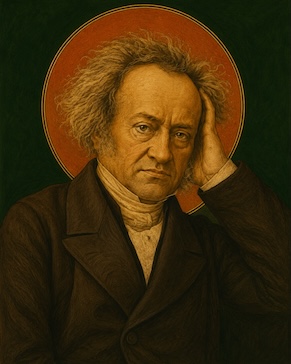
John McKaeg (mid 19th century)
Australian Baptist witness has an inconvenient founding figure, and it’s worth naming him honestly rather than tidying him up. Born in Lochgilphead, Argyllshire, McKaeg trained at the Baptist Academy at Horton and served as a missionary to Roman Catholic Ireland before taking his one settled pastorate, at Bingley in Yorkshire — which ended so badly that the local Baptist Association excluded his church, and one fellow minister judged him simply “quite mad.” Calling himself “the poor highlander,” he arrived in Sydney in 1831, alone and sent by no society, and on 24 April conducted the first Baptist service in Australia in the Long Room of the Rose and Crown Inn, followed the next year by the colony’s first baptisms in Woolloomooloo Bay, watched by a crowd more curious than devout. A land grant and building committee followed, but McKaeg could not sustain what he had started. Money borrowed to buy into a tobacco business collapsed under what one contemporary called his “unbusinesslike and drunken habits,” and he ended up in debtors’ prison, where he was caught gambling. On 27 October 1836 — within weeks of the first Baptist chapel finally opening in Bathurst Street under his steadier successor, John Saunders — McKaeg, in despair, cut his own throat. He survived; what became of him afterward is not recorded. We don’t include him as a model of faithfulness sustained — he plainly wasn’t. We include him because pioneering is often like this: an unstable, under-resourced, ordinary person cracks a door open that better-equipped people walk through afterwards, and because a tradition willing to name its own founder honestly, tragedy and all, is in better shape than one that turns him into a plaster saint.
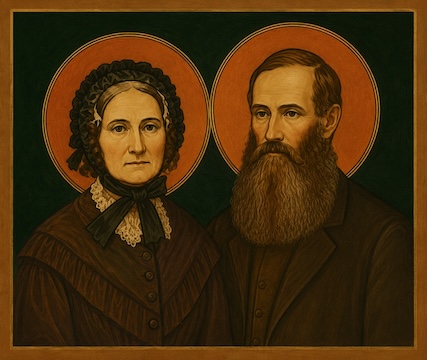
Joseph & Caroline Wilson (19th century)
The Wilsons stand closer to home than most names on this page — among the founders of our own church. In August 1855, Joseph Wilson, then Secretary of the young Prahran Baptist congregation, personally donated the block of land in Chapel Street, South Yarra, that would become the church’s permanent home for more than one hundred years. The following year, still as Secretary, he moved the resolution calling for closer “union, fellowship, mutual co-operation” among Victoria’s scattered Baptist churches — a resolution the congregation’s own centenary history credits with setting in motion the movement that became the Baptist Union of Victoria. In 1859 Joseph became the congregation’s first pastor, unpaid, living on whatever remained in the general fund after expenses. The Wilsons later became key figures in the early life of Lilydale Baptist Church. Much of what we know of Caroline, and of the fuller shape of their partnership in ministry, survives only in family memory and in Bright Hopes for Tomorrow, a privately printed account now out of print — we include them here because a church that forgets its own founders too easily forgets how contingent and human its own beginnings were.
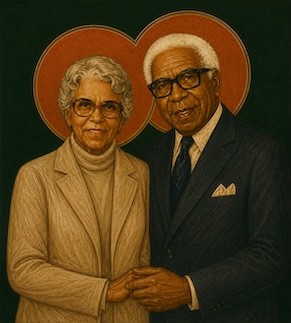
Doug & Gladys Nicholls (1906–1988 / 1906–1981)
In the mid-1930s, Doug Nicholls — a Yorta Yorta man from Cummeragunja, already known across Victoria as a champion footballer — founded the first Aboriginal Church of Christ in Australia, in Gore Street, Fitzroy. This was not a mission run for Aboriginal people by others; it was a congregation gathered and led by an Aboriginal pastor, on Aboriginal terms, in the middle of a city that mostly refused Aboriginal people any standing at all. Gladys, who married Doug after the death of her first husband (Doug’s brother Howard), taught Sunday school there and built the welfare networks — food, shelter, a Christmas giving tree for children — that held the surrounding community together. Together they pioneered a pattern that didn’t yet exist: Christian discipleship and Aboriginal political advocacy as a single, undivided vocation, carried from a Fitzroy chapel all the way to the corridors of federal parliament and, eventually, Government House in Adelaide.
Those who paid the ultimate price for following in the footsteps of Jesus
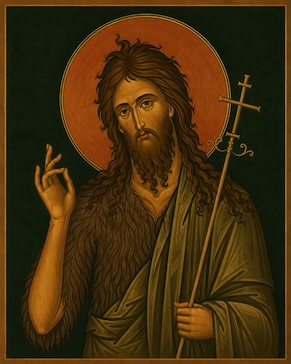
John the Baptiser (d. c. AD 30)
The last and greatest of the prophets, by Jesus’s own account, John lived in the wilderness on locusts and wild honey and preached a baptism of repentance that drew crowds out of the cities to the Jordan. He was utterly unimpressed by power: he told Herod Antipas to his face that his marriage to his brother’s wife Herodias was unlawful, and kept saying it from prison rather than let the matter drop. Herodias wanted him dead for it; Herod, superstitious and half-convinced John was a holy man, hesitated — until a drunken promise made to please a dancing girl at a banquet left him cornered into keeping his word. John’s head was brought in on a platter to satisfy a grudge and a boast. He died, in the end, not for blasphemy or rebellion but for telling a king the plain truth about his own marriage bed, which may be the most Baptist way to be martyred that there is.
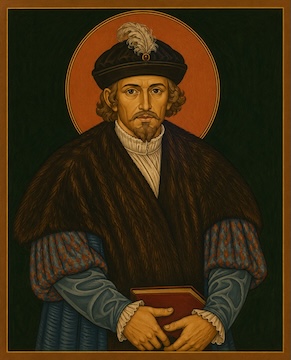
Conrad Grebel (c.1498–1526)
Grebel is remembered as the “father of the Anabaptists” — the founder, with Felix Manz and George Blaurock, of the first Anabaptist congregation, formed in a private home in Zurich in January 1525 when Grebel baptised Blaurock as an adult believer in direct defiance of Zurich’s law. It’s worth being precise about how his own story ended: unlike his friends, Grebel was not executed. Manz was drowned by the city authorities in 1527; Blaurock was burned at the stake in 1529. Grebel himself was arrested, imprisoned, and escaped, and died of the plague in 1526 while a fugitive, worn down by months of hardship and flight — sickness, not the executioner, caught up with him first. We include him here less because of how he died than because of what dying young and hunted, in the middle of founding a movement that would go on costing his closest friends their lives, actually looks like: it is rarely as clean as martyrdom. Believer’s baptism, congregational autonomy, and the separation of church from state — convictions this congregation still holds — trace back to a handful of frightened, defiant people meeting in a Zurich front room, most of whom did not live to see thirty.
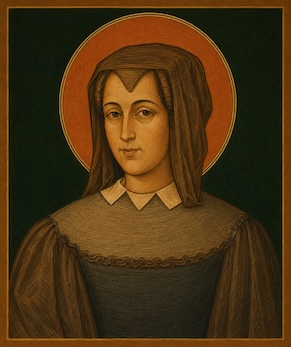
Elizabeth Gaunt (d. 1685)
Gaunt was a London Anabaptist shopkeeper known, in the words of a contemporary, for spending her life “visiting gaols, and looking after the poor of what persuasion soever they were” — Christian charity with no test of loyalty or denomination attached. That charity is what killed her. After the failed Monmouth Rebellion of 1685, she sheltered one of the fugitives, James Burton; when he was later caught, he purchased his own pardon by informing on her. She was convicted of treason and, denied the mercy of strangulation first, burned alive at Tyburn on 23 October 1685 — the last woman ever executed in England for a political or religious offence. Witnesses, including William Penn, described her extraordinary composure at the stake; she is said to have arranged the straw around herself to shorten her own suffering. In a paper written the night before in Newgate, she said simply: “My fault was one which a prince might well have forgiven. I did but relieve a poor family; and lo! I must die for it.” She died for exactly the kind of unconditional hospitality this congregation tries, however imperfectly, to practise.

Dietrich Bonhoeffer (1906–1945)
A German Lutheran pastor and theologian, Bonhoeffer recognised earlier than most of his church that Nazism was not a political inconvenience but a rival gospel demanding the church’s outright refusal. He helped found the Confessing Church in opposition to the Nazified state church, ran an illegal underground seminary after it was banned, and wrote with piercing clarity about the difference between “cheap grace” — forgiveness with no cost and no change of life — and the “costly grace” that actually costs a disciple something. Involvement in a failed plot against Hitler’s life led to his arrest in 1943. He was hanged at Flossenbürg concentration camp on 9 April 1945, weeks before the war’s end and the camp’s liberation. His last recorded words, to a fellow prisoner as he was led away: “This is the end — for me, the beginning of life.”

Oscar Romero (1917–1980)
Appointed Archbishop of San Salvador in 1977 as a safe, cautious choice expected to leave the status quo undisturbed, Romero was transformed within weeks by the murder of his friend Father Rutilio Grande at the hands of a government death squad. For three years afterward, his Sunday homilies were broadcast by radio across El Salvador; the rural poor gathered around transistor radios to hear an archbishop say plainly, on national airwaves, that God saw what was being done to them. He pleaded directly with US President Carter to stop arming the regime, and named the disappeared by name from the pulpit when no one else dared. On 24 March 1980, he was shot through the heart while celebrating Mass at the altar, the day after a homily calling on soldiers to disobey orders to kill civilians. He was canonised in 2018.

Martin Luther King Jr. (1929–1968)
A Baptist preacher from the Black church tradition, King fused the theology of the Social Gospel with the nonviolent philosophy of Gandhi into a vision of the “beloved community” that reshaped a nation’s conscience. His sermons and speeches — “I Have a Dream,” “Letter from Birmingham Jail,” “I’ve Been to the Mountaintop,” delivered the night before his death — remain among the greatest works of public oratory in American history. He was under constant surveillance and harassment by the FBI, which called him the most dangerous man in America; that judgment, made by the very apparatus of state power he confronted, is itself a kind of tribute. He was assassinated in Memphis on 4 April 1968, aged thirty-nine, while in the city to support striking sanitation workers — killed, in the end, in the course of ordinary solidarity with underpaid Black labourers, not in some more abstractly heroic moment.
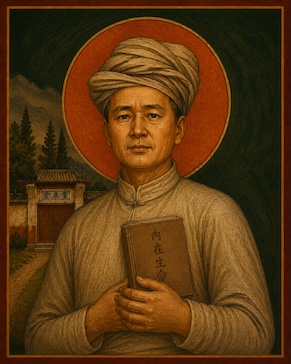
Wang Zhiming (1907–1973)
A Miao pastor in Wuding County, Yunnan, China, Wang led his congregation through the Christianisation of the region’s Miao people that had begun a generation earlier under missionaries such as Samuel Pollard, and then through the far harder test of the Cultural Revolution. Openly critical of the atheist campaigns of the local Red Guards, he was arrested with members of his own family in 1969; seven of his relatives were persecuted alongside him over the following years. After a public denunciation rally attended by some ten thousand people, he was executed on 29 December 1973. It was not until after the Cultural Revolution ended that his family received formal “rehabilitation” restoring his public reputation. A monument now stands at his grave — the only memorial in China to a Christian killed in the Cultural Revolution — and his statue is one of ten twentieth-century martyrs carved above the Great West Door of Westminster Abbey. In the decades since his death, the church he served has grown from around 2,800 believers to some 60,000.
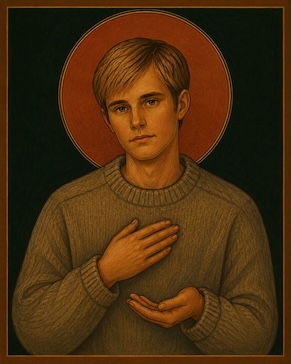
Matthew Shepard (1976–1998)
A twenty-one-year-old university student in Wyoming, Matthew Shepard was targeted for being gay. He was lured from a bar, robbed, savagely beaten, and tied to a fence in near-freezing temperatures, left for eighteen hours before he was found — barely alive, and unrecognisable to the cyclist who discovered him, who at first mistook him for a scarecrow. He died six days later without regaining consciousness. His death became one of the defining moments in the modern movement against anti-LGBTQ violence in America, prompting a candlelight vigil on the steps of the US Capitol and, eleven years later, the federal hate-crimes legislation that bears his name. We name him among those who paid the ultimate price for following Christ not because he was a professed martyr of the faith, but because a church that claims Christ is found among the outcast and the beaten has to be willing to say his name plainly, and to recognise the shape of the cross in what was done to him.
Those who left us spiritual writings which continue to inspire faith and hope

Julian of Norwich (c.1342–c.1416)
At thirty, gravely ill and given up for dead, Julian received a series of visions of the crucified Christ. She recovered, and spent the next twenty years turning those visions over in prayer and writing about them, producing Revelations of Divine Love — the earliest surviving book written in English by a woman, and one of the most theologically daring texts in the whole tradition. As an anchoress, living out her life enclosed in a small cell attached to a Norwich church, she nonetheless became a counsellor to everyone who came to her window seeking wisdom. Her best-known line — “all shall be well, and all shall be well, and all manner of thing shall be well” — is routinely mistaken for naive comfort; read in context, alongside her insistence on God’s motherhood and her refusal to let divine wrath have the last word, it is one of the most hard-won and theologically radical statements of trust in the literature of the church.
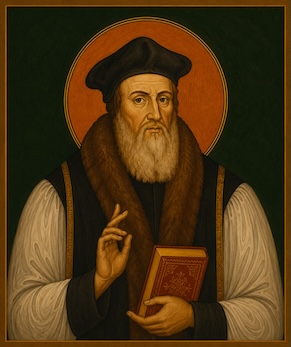
Thomas Cranmer (1489–1556)
As Archbishop of Canterbury under Henry VIII and Edward VI, Cranmer did more than perhaps anyone else to give the English Reformation its enduring literary voice, chiefly through his authorship of the Book of Common Prayer — prose so rhythmically exact that whole phrases from it (“ashes to ashes, dust to dust”; “till death us do part”) have passed into everyday English quite apart from their religious origin. When the Catholic Mary I came to the throne, Cranmer was tried for heresy and, under intense pressure, signed several recantations of his Protestant beliefs. At his execution in 1556, in a final reversal, he renounced the recantations instead and thrust the hand that had signed them first into the flames, saying it should burn first since it had offended. Whatever one makes of the theology he fought for, the Prayer Book he wrote has shaped how English-speaking Christians of many traditions — including, at several removes, our own liturgical instincts — have prayed together for nearly five hundred years.
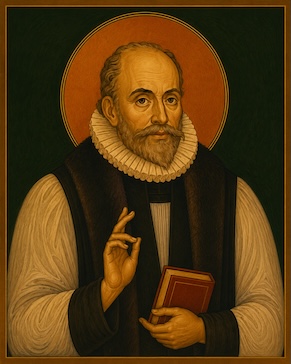
Thomas Helwys (c.1575–1616)
A Nottinghamshire lawyer turned dissenting theologian, Helwys founded, in 1611–12, the first Baptist congregation on English soil, in Spitalfields — having deliberately returned from safety in Amsterdam because he believed it was wrong to escape persecution while leaving others to face it. In 1612 he published A Short Declaration of the Mystery of Iniquity, the first sustained argument in the English language for full religious liberty — not merely for Protestants, but, remarkably for its time, for Catholics, Jews, Muslims, and those of no religion at all, on the grounds that the human conscience answers to God alone. He sent King James I a personal copy with a handwritten inscription telling the king plainly that he was “a mortal man, and not God,” with no authority over his subjects’ souls. The king had him thrown into Newgate Prison, where he died, still only in his early forties, sometime around 1616. Believer’s baptism and congregational independence are only half of what Helwys bequeathed to Baptist life; the other half is the conviction, argued at the cost of his own life, that liberty of conscience belongs to everyone or it belongs to no one.
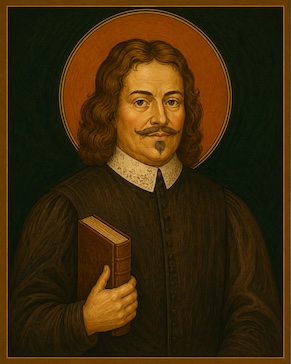
John Bunyan (1628–1688)
A tinker by trade with almost no formal education, Bunyan was imprisoned for some twelve years in Bedford gaol for the crime of preaching without a licence from the Church of England. It was there that he wrote The Pilgrim’s Progress, an allegory of one man’s journey from the City of Destruction to the Celestial City that went on to become, for the better part of three centuries, the best-selling book in the English language after the Bible itself — translated into hundreds of languages, read aloud in cottages and mission stations across the world by people who had never read another work of literature. Its staying power lies less in its theology, which is fairly conventional Puritan fare, than in its extraordinary, plain-spoken sense of what the inner life of struggle, doubt, and perseverance actually feels like — Bunyan wrote from a prison cell about the difficulty of the road, and readers in every kind of difficulty since have recognised themselves in it.
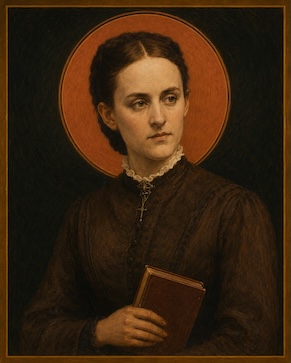
Anne Steele (1717–1778)
The daughter of an unpaid Baptist lay pastor in the small Hampshire village of Broughton, Steele suffered a severe hip injury at nineteen that left her in poor health for life, and lost her fiancé to drowning the day before their wedding. Out of a life marked by disappointment and physical suffering, writing under the modest pen name “Theodosia,” she produced 144 hymns and 34 metrical psalms that became, for the following century, more widely sung in English and American hymnals than the work of any other woman — in one 1808 Boston hymnal, 59 of its 144 hymns were hers alone. Her verse rarely reaches for theological complexity; its power lies in its unflinching honesty about grief and its equally unflinching return, again and again, to trust. She never married, choosing instead — as she put it in one poem — to devote her single life fully to writing and to God, and the epitaph on her Broughton gravestone imagines her, finally free of the “silent lyre,” joining in heaven the song she had spent her earthly life composing about.
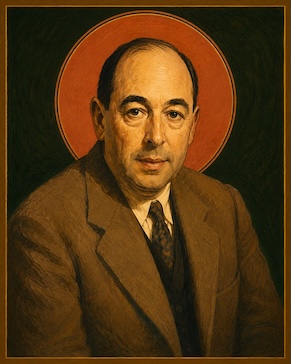
C.S. Lewis (1898–1963)
An Oxford and later Cambridge scholar of medieval literature, Clive Staples Lewis came to Christian faith reluctantly in his thirties, later describing himself as “the most dejected and reluctant convert in all England.” What followed was one of the twentieth century’s most wide-ranging bodies of Christian writing: apologetics such as Mere Christianity, born from wartime BBC radio talks; searching, unsentimental reflection on suffering in The Problem of Pain and, after the death of his wife Joy, the far rawer A Grief Observed; and, best known of all, the Narnia stories, which smuggled the shape of the Christian story into the imagination of children (and adults) who would never have picked up a work of formal theology. He wrote for the intelligent sceptic as much as for the believer, with a clarity and wit that has kept his work in print, and in active use by people of many different traditions, for over half a century since his death.
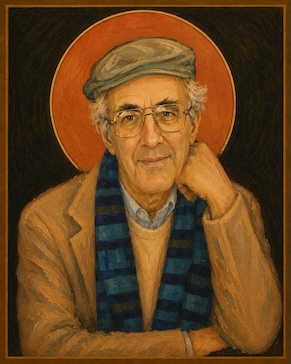
Henri Nouwen (1932–1996)
A Dutch Catholic priest and academic who taught at Notre Dame, Yale, and Harvard, Nouwen wrote with unusual candour about his own loneliness, anxiety, and need — the conviction, expressed most fully in The Wounded Healer, that ministers help others not despite their own brokenness but through an honest reckoning with it. In 1986, at the height of his academic reputation, he left it all behind to become pastor to L’Arche Daybreak, a community in Toronto where people with intellectual disabilities and their assistants share ordinary life together; his years there, especially his friendship with a core member named Adam, reshaped his later writing, above all The Return of the Prodigal Son, a meditation on Rembrandt’s painting of the same name that has become one of the most loved works of contemporary spiritual writing. He spent his last decade, in other words, proving in his own life the thing his books had always argued: that the way to God usually runs through weakness, not strength.
Those who taught us to unite the quest for justice with the life of prayer

Francis of Assisi (1181–1226)
The son of a wealthy cloth merchant, Francis renounced his inheritance in a public scene in the piazza of Assisi — stripping off his clothes before the bishop and his own furious father — to live in total poverty among the poor. He rebuilt a ruined chapel with his own hands, gathered a community of brothers who owned nothing and begged for their bread, and insisted that care for creation, care for the poor, and a life of ceaseless prayer were not three separate concerns but one single thing. During the Crusades he crossed the lines to meet the Sultan of Egypt, seeking peace through conversation rather than conquest — an act of extraordinary nerve for its time. The stories that have grown up around him — preaching to birds, taming a wolf that had been terrorising a town — read as whimsy, but they preserve something exact about him: a man for whom prayer was never separable from how you treat the most vulnerable creature in front of you.
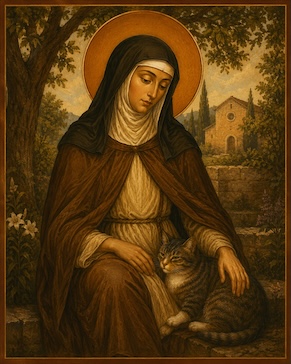
Clare of Assisi (1194–1253)
Inspired by Francis’s preaching, Clare fled her noble family’s home at eighteen to join his movement, and went on to found the Poor Clares, an order of women committed to the same absolute poverty the friars had chosen for themselves. She fought for decades — against considerable pressure from a church hierarchy uncomfortable with women choosing destitution rather than the security of a dowered convent — to win papal approval for a rule that let her sisters own literally nothing, individually or in common, trusting daily bread to arrive by begging alone. It was the first monastic rule ever written by a woman for other women. Bedridden for the last thirty years of her life, she is said to have once held off an attacking army simply by having herself carried to the convent gate with the sacrament raised before her — whether historical fact or legend, it captures how her contemporaries understood the relationship between her prayer and her courage: inseparable, and formidable.
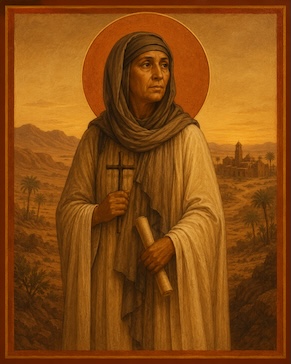
Amma Syncletica (4th century)
Born to a wealthy family in Alexandria, Egypt, Syncletica gave away her entire inheritance after her parents’ deaths and withdrew, with her blind sister in her care, to live as a hermit among the cave-tombs outside the city — deliberately choosing the language of poverty and dispossession over the security her birth had guaranteed her. Word of her wisdom spread, and women seeking spiritual direction began seeking her out one by one, becoming in time a community of women ascetics gathered around her teaching. Her sayings, recorded alongside those of the male Desert Fathers in the Apophthegmata Patrum, are unsparing about the cost of a life turned toward God: “Many are the wiles of the devil,” she taught, and progress in prayer without struggle against injustice both within oneself and around it was, for her, no progress at all. She is one of very few women whose voice survives at all from the formative first centuries of Christian monastic and contemplative life, teaching then, as she teaches now, that withdrawal from the world and hard-eyed honesty about the world are not opposites.

Pandita Ramabai (1858–1922)
Born into a high-caste Hindu family unusually committed, for its time, to educating its daughters, Ramabai became a Sanskrit scholar, translator, and reformer whose life was reshaped by widowhood at a young age and by her encounter with Christian women working among India’s poorest communities. She founded Mukti Mission near Pune, which at its height housed, fed, and educated well over a thousand destitute women and children — child widows, famine orphans, women rescued from trafficking — combining rigorous Christian devotion with an unrelenting practical commitment to their dignity and independence. For Ramabai these were never separate projects: the gospel she preached was inseparable from the schools, workshops, and refuges she built to embody it. In one of the great feats of biblical scholarship by any translator, she rendered the entire Bible into Marathi directly from the original Hebrew and Greek — scholarly labour undertaken alongside, not instead of, the daily work of running a refuge for society’s most discarded women. Alongside her scholarship and reform work, Ramabai gave herself to a life of sustained prayer. In 1905, a prayer circle she gathered at Mukti — which grew within months from seventy women to 550, meeting twice daily and interceding by name for tens of thousands of people — broke into weeks of weeping, confession, and prayer meetings that at times ran through the night. What became known as the Mukti Revival spread across the region and is now regarded by historians of global Christianity as one of the founding events of Pentecostalism outside the West, arising largely independently of the roughly contemporaneous revival at Azusa Street. Once again, for Ramabai, prayer of this depth and justice on the ground were not separate pursuits: the same women crying out in intercession were the ones running the schools, the refuges, and the translation work.
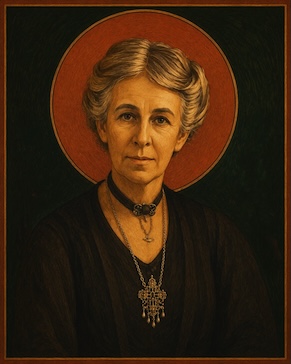
Evelyn Underhill (1875–1941)
An Anglican laywoman rather than a professional theologian or member of religious orders, Underhill became one of the twentieth century’s most influential writers on Christian mysticism, above all through her landmark 1911 study Mysticism, which introduced the contemplative tradition to a much wider English-speaking readership than it had previously reached. Her own spiritual life deepened significantly through her later friendship with the Baron Friedrich von Hügel, who pushed her away from a purely private, interior mysticism toward a firmer grounding in institutional worship and social compassion — she became increasingly convinced that contemplation which did not issue in practical charity and engagement with a suffering world was incomplete, even dangerous. A committed pacifist in her later years, she worked extensively with wartime refugees. Her writing on prayer and retreats — practical, unpretentious, deeply read in the mystics but never merely academic — shaped generations of retreat-givers and spiritual directors across denominations, this congregation’s own liturgical instincts among them.
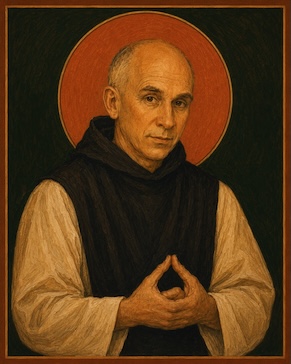
Thomas Merton (1915–1968)
A Trappist monk at the Abbey of Gethsemani in Kentucky, Merton entered contemplative life seeking to leave the world behind, and became instead one of the century’s most searching public voices on exactly how contemplation and engagement with the world’s injustice belong together. His bestselling autobiography The Seven Storey Mountain made him famous; the decades of writing that followed — on nonviolence, nuclear weapons, racism, and interfaith dialogue with Buddhist and other traditions — showed a monk whose withdrawal into silence and prayer only sharpened his sense of solidarity with those suffering outside the monastery walls. He corresponded with, among many others, Dorothy Day, whose Catholic Worker movement embodied from the other direction the same conviction he was reaching in his cell: that prayer disconnected from justice curdles into escapism, and justice disconnected from prayer burns out. He died accidentally, electrocuted by a faulty fan, while attending an interfaith monastic conference in Bangkok.
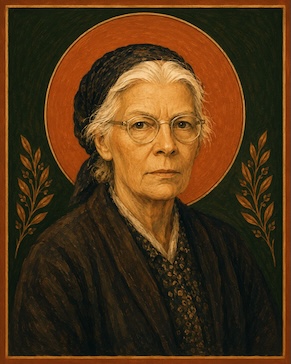
Dorothy Day (1897–1980)
A journalist and, in her youth, a bohemian radical involved in labour agitation and left-wing politics, Day converted to Catholicism in her late twenties — a decision that cost her a relationship she loved, but which she experienced as the fulfilment rather than the betrayal of her commitment to the poor. With Peter Maurin she co-founded the Catholic Worker movement in 1933, combining a newspaper, houses of hospitality that fed and sheltered the destitute in the middle of the Depression, and an uncompromising, prayer-soaked pacifism that put her at odds with a nation gearing up for war more than once. She lived the rest of her life in voluntary poverty alongside the people the movement served, insisting that the Mass and the soup kitchen were, properly understood, the same act of worship. Asked whether she considered herself a saint, in a phrase that has outlived almost everything else she said, she is reported to have replied that she didn’t want to be dismissed that easily.
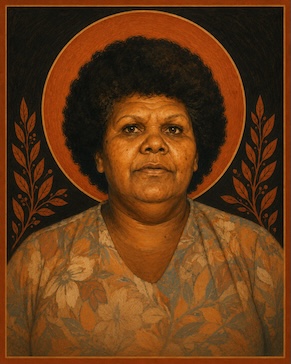
MumShirl Smith (c.1921–1998)
A Wiradjuri woman born on the Erambie Mission near Cowra, Shirley Smith — known across Sydney simply as Mum Shirl — began her decades of advocacy visiting her brother in prison and, finding so few other Aboriginal people had anyone to visit them, kept going back for everyone else too. From that beginning she became an unofficial chaplain, foster mother, and welfare worker to the whole Aboriginal community of Redfern, informally fostering and caring for scores of children over her lifetime, and was a founding figure behind the Aboriginal Legal Service, the Aboriginal Medical Service, the Aboriginal Children’s Service, the Aboriginal Housing Company, and the Aboriginal Tent Embassy. A devout Catholic who worshipped for decades alongside the priest Ted Kennedy at St Vincent’s, Redfern, she was, in his words, someone with “a capacity to comfort the afflicted” who never let that stop her from also “afflicting the comfortable.” Sometimes called the “Black Saint of Paddington,” she was formally recognised in her lifetime as an Australian National Living Treasure — official acknowledgment, decades late, of a ministry that had never waited for anyone’s permission to begin.
Those whose insights helped us see new light and truth breaking forth from God’s Word

The Apostle Paul of Tarsus (c.5–c.67 AD)
More than anyone else in the New Testament, Paul is responsible for working out what the story of Jesus actually meant — not just retelling it, but thinking it through, argument by argument, letter by letter, often in the middle of conflict with churches he had planted himself. His insight that in Christ “there is neither Jew nor Greek, slave nor free, male nor female” cracked open a horizon the early church spent centuries trying to catch up with, and arguably still is. He read Israel’s scriptures and found in them, to his own initial horror and eventual joy, a gospel wide enough to include Gentiles without requiring them to become Jews first — a theological breakthrough achieved through real argument, real reversal, and real cost to his own standing with people he’d once agreed with. Whatever the difficulties of his letters — and there are real ones — the habit of thinking hard, in public, in the middle of a live pastoral crisis, about what the text in front of you actually demands, is one this congregation inherits directly from him.
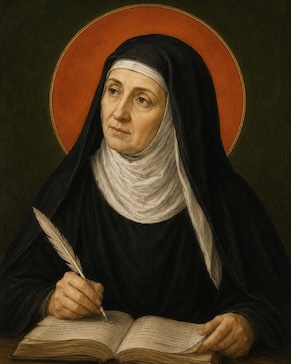
Hildegard of Bingen (1098–1179)
A Benedictine abbess, composer, scientist, and visionary, Hildegard experienced vivid visions from childhood but didn’t begin writing or speaking about them publicly until her forties, overcoming what she described as years of fearful silence before a divine commission finally overcame her hesitation. What followed was an extraordinary body of theological writing, alongside sacred music still performed today and treatises on medicine and the natural world, all held together by her central insight: viriditas, the “greening power” of God alive and active in creation itself. She conducted four preaching tours through the Rhineland — remarkable for a woman of her era — and corresponded as an equal with popes and emperors who sought her counsel. Her conviction that God’s truth is written into the physical, growing world as much as into scripture speaks with unusual freshness to a church living through ecological crisis, and she remains one of only four women named a Doctor of the Church.
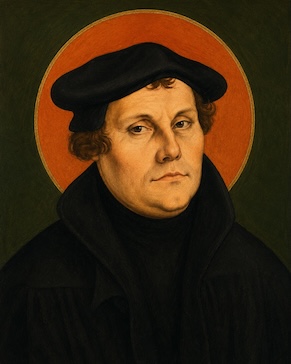
Martin Luther (1483–1546)
An Augustinian monk tormented by a God he experienced as endlessly demanding, Luther’s breakthrough came through close, obsessive re-reading of Paul’s letter to the Romans, where he became convinced that righteousness before God was a gift received by faith, not a performance achieved by works — a rediscovery, as he experienced it, of something the church of his day had buried under centuries of accumulated practice. His posting of the Ninety-Five Theses in 1517 set off the Reformation, and his German translation of the New Testament put scripture directly into the hands of ordinary readers for the first time, reshaping the German language itself in the process. None of this makes him a straightforwardly admirable figure — his later writings against the Jewish people are a matter of documented historical record and lasting harm, cited by antisemites for centuries afterward, and his response to the Peasants’ War revealed a man capable of siding decisively with power against exactly the poor his theology should have liberated. We honour the insight into grace without pretending the man who had it was safe to imitate wholesale.
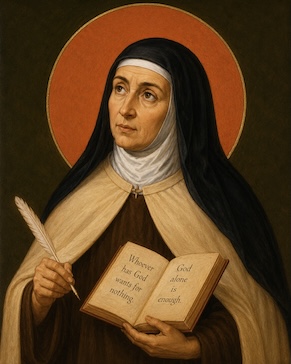
Teresa of Ávila (1515–1582)
A Spanish Carmelite nun, Teresa reformed her order from within, founding austere new convents in the face of fierce institutional resistance, while writing some of the most psychologically exact accounts of prayer and mystical experience in the whole Christian tradition — above all in The Interior Castle, which maps the soul’s journey toward God through a series of inner chambers with a precision that still startles contemplatives today. She was investigated more than once by the Inquisition for the audacity of a woman claiming direct, unmediated experience of God, and had to defend both her visions and her right to write about them at all. Alongside John of the Cross, she helped the Western church take mystical prayer seriously again at a time when it was treated mostly as a danger to be guarded against rather than a discipline to be practised — insisting that vivid inner experience of God and rigorous, unsentimental self-examination were not opposites but the same discipline, seen from two directions.
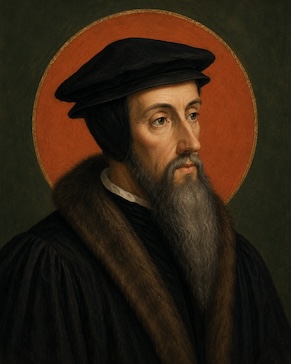
John Calvin (1509–1564)
A French lawyer turned reformer, Calvin gave the Protestant Reformation its most systematic and enduringly influential theological architecture in the Institutes of the Christian Religion, a work he kept revising and expanding across his lifetime. His insistence on the absolute sovereignty of God, and his conviction that scripture should be read and preached in a manner accessible and applicable to ordinary life, shaped Reformed, Presbyterian, and Baptist traditions alike — including strands of Calvinist conviction that ran through the earliest English Baptists this congregation descends from. Geneva, under his influence, became something close to a theocracy, and his role in the trial and execution of Michael Servetus for heresy remains a serious and troubling blot on his legacy — a reminder that real theological insight can sit inside the same person as the ruthless use of institutional power. We read him for the rigour of his thought about grace and sovereignty, not for a model of how to treat those who disagree.
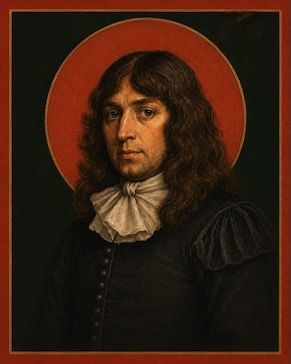
John Smyth (c.1554–1612)
An Anglican priest turned Separatist turned, eventually, founder of the first identifiably Baptist congregation, Smyth reached his defining insight the hard way: reading scripture afresh in exile in Amsterdam, he concluded that infant baptism had no basis in the New Testament and that only a deliberate, adult confession of faith could rightly precede it. Finding no one else he considered qualified to administer it, he baptised himself, then baptised the rest of his congregation — an act so unprecedented it earned him the nickname “the Se-Baptist.” Restless and unusually willing, by the standards of his age, to admit when further study had proven him wrong, Smyth changed his mind about nearly everything over the course of his short ministry — from Anglican, to Puritan, to Separatist, to self-baptising Baptist, to, in his final year, an aspiring Mennonite. Where most of his contemporaries treated changing your theological position as a scandal to be hidden, Smyth built the possibility of being wrong into his own confession of faith: “If any shall do us that friendly part,” he wrote, “to show us from the word of God that which we see not, we shall have cause to be thankful to God and them.” It cost him nearly everything: his own congregation split under the strain of his reversals, Thomas Helwys among those who would not follow him further, and Smyth died in Amsterdam in 1612, mid-application to a Mennonite church that had not yet decided whether to accept him. Believer’s baptism, one of this tradition’s most basic convictions, was hammered out this unstably, by a man who wrote correction into his own confession as a gift rather than a threat.

Athol Gill (1937–1992)
A New Testament scholar and Baptist minister, Athol Gill opened the eyes of a generation of Australian Christians — a number of them in this congregation — to what radical, literal discipleship to Jesus could look like without curdling into either biblical literalism or safe social conservatism. He founded the House of the Gentle Bunyip, an intentional Christian community in inner-city Melbourne committed to shared life and solidarity with the poor, and taught New Testament at Whitley College for decades. When conservative elements within the Baptist Union of Victoria moved to block his reappointment as Professor, Gill volunteered to stand before the entire Assembly and answer questions about his faith and scholarship for two hours — after which he was overwhelmingly reinstated. He died suddenly of a heart attack in 1992, at the height of his influence, leaving a gap in Australian Baptist theological life that has arguably never been fully filled.
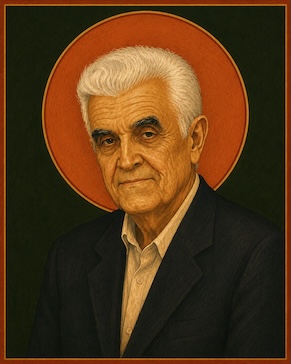
René Girard (1923–2015)
A French historian, literary critic, and philosopher rather than a professional theologian, Girard arrived at one of the most theologically consequential insights of the last century almost by accident, through his study of the great works of Western literature: that human desire is fundamentally mimetic — we want things because others want them — and that this rivalry, scaled up across whole communities, resolves itself again and again through the same mechanism, the expulsion or killing of a single scapegoat whose death (falsely) restores peace. What made Girard’s work theologically explosive was his argument that the Gospels are unique among humanity’s foundational texts precisely because they refuse to hide this mechanism — they tell the scapegoating story from the victim’s side, exposing rather than sanctifying it, and in doing so undermine the whole logic of sacred violence from within. For a congregation whose theological commitments include a thoroughgoing rejection of penal substitutionary atonement, Girard’s account of the cross as God’s unmasking of scapegoating violence rather than its ultimate, sanctioned instance is not one insight among many — it is close to the theological centre of how we read the whole story.
Those whose courageous leadership opened our eyes to see Christ among the outcasts and victims
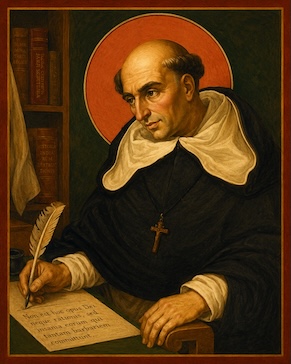
Bartolomé de las Casas (1484–1566)
A Spanish colonist who arrived in the Caribbean as a young man and initially benefited directly from the encomienda system — forced Indigenous labour granted to Spanish settlers — Las Casas underwent a wrenching conversion around 1514, freed the people he held, and spent the rest of his long life as the most relentless and effective critic Spanish colonialism produced from within its own ranks. His book A Short Account of the Destruction of the Indies documented, in horrifying detail, the scale of violence being done to Indigenous peoples in the name of Christian conquest, and he lobbied the Spanish crown for decades, eventually securing the New Laws of 1542, which attempted (with only partial success) to curb the worst abuses. It’s worth being honest about the limits of his moral vision too: earlier in his campaign, he supported increased African slave labour as a supposed alternative to Indigenous forced labour, a position he later recognised as its own grave sin and explicitly repented of in his later writings. Appointed Bishop of Chiapas, he continued to fight colonial abuse from within the church’s own hierarchy until his death. He remains one of the earliest and clearest examples of a Christian leader using institutional standing to name colonial violence as sin rather than providence.

John Saunders (1806–1859)
The founding pastor of the first enduring Baptist church in Australia, Saunders arrived in Sydney in 1834 and built Bathurst Street Baptist Church into an intentionally open, ecumenical congregation that welcomed Christians of every denomination to membership and the Lord’s table — unusual generosity for Baptists of his era. His most consequential act of leadership came in October 1838, in the immediate aftermath of the Myall Creek massacre, in which a group of colonists murdered at least twenty-eight unarmed Wirrayaraay men, women, and children. Saunders preached a sermon, described by historian Henry Reynolds as one of the most eloquent statements of humanitarian doctrine to come out of that period, insisting plainly that Aboriginal people were fully human, made in the image of God, and that the colony’s treatment of them was a sin demanding repentance and restitution — a position that placed him well outside the comfortable consensus of colonial society, delivered at real risk to his own standing.

Sojourner Truth (c.1797–1883)
Born into slavery in New York as Isabella Baumfree, Truth escaped to freedom in 1826 and underwent a conversion so overwhelming she described it as seeing God face to face. Taking a new name — Sojourner, because she was called to travel, Truth, because she was called to speak it — she began standing before white audiences across the antebellum United States as an illiterate Black woman who spoke with a power that regularly left rooms in stunned silence. Her best-known speech, delivered at a women’s rights convention in 1851 and remembered by its refrain “Ain’t I a Woman?”, remains one of the sharpest pieces of rhetoric in American history. In it, she confronted a room of mostly white women with the fact that their idea of “womanhood” quietly excluded her — a formerly enslaved Black woman who had ploughed fields and borne the whip alongside any man. She refused the same narrowing from the other direction too: the abolition movement of her day was led mostly by men, with women’s voices, especially Black women’s, pushed to the margins. Truth simply declined to be split in two — she stood up as a Black woman demanding rights, not a cause divided against itself, and made both movements answer to the whole of who she was. She understood her own life as prophetic testimony: that the dignity of Black women could not be argued away by either racism or sexism, and she delivered that testimony for forty years.
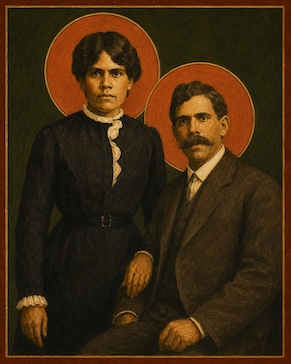
Ellen & Edwin Atkinson (1894–1965 / 1888–1952)
Ellen and Edwin — known to their community as Eddy — met and married at Cummeragunja, a government reserve on the Murray River, in 1911, and lived there as farmers and seasonal labourers until a Christian mission’s visit in 1913 changed the direction of both their lives. Eddy began preaching, unpaid, eventually becoming the reserve’s pastor; Ellen played the organ and ran Sunday school. Their faith never separated itself from the injustice around them: through the hardships of the Depression they supported Aboriginal activists William Cooper, William Ferguson, and Jack Patten in organising protest against discriminatory government policy, and in 1939, when authorities moved to dismantle the thriving farming community Cummeragunja had become, the Atkinsons were among those who crossed the Murray in protest and camped in exile on the Victorian side rather than accept it quietly — the Cummeragunja walk-off, one of the earliest organised acts of Aboriginal industrial and political protest in Australian history. Leadership, for the Atkinsons, looked like ordinary, unpaid faithfulness to a congregation, married to a willingness to walk off the land itself when justice required it.
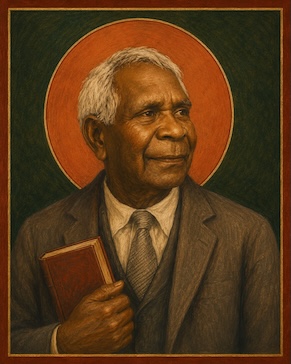
David Unaipon (1872–1967)
A Ngarrindjeri man from Point McLeay Mission (now Raukkan) in South Australia, Unaipon spent decades touring the country as a preacher and public speaker, using pulpits and platforms most Aboriginal people of his era were never offered to press white Australia to reckon with Aboriginal humanity, culture, and rights. He was also a genuinely gifted inventor — his modified shearing handpiece was widely adopted across the wool industry, though he was too poor ever to secure a full patent and was never properly paid for it — and the first Aboriginal author published in English, compiling Legendary Tales of the Australian Aborigines from stories gathered on his travels. He gave evidence to government inquiries and consistently urged that Aboriginal affairs be brought under federal rather than state control. He was not a simple or uncomplicated figure — his commitment to Christian mission and to assimilationist policy put him at odds, later in life, with a rising generation of more radical Aboriginal activists — but he spent a lifetime insisting, in pulpit, patent office, and print alike, that Aboriginal intellect and Aboriginal humanity be taken with full seriousness by a country determined not to. He died in February 1967, months before the referendum that would finally count Aboriginal people as citizens.
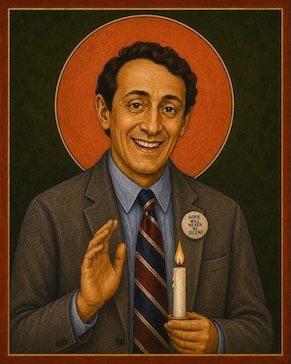
Harvey Milk (1930–1978)
Harvey Milk was the first openly gay man elected to public office in California, winning a seat on the San Francisco Board of Supervisors in 1977 after several earlier defeats. He is not a figure of Christian faith — by most accounts he had little time for organised religion at all — and we include him here deliberately anyway, because a church that claims to see Christ among the outcast and the victim has to be able to recognise that pattern in a life lived entirely outside its own walls. Milk used his brief time in office to champion a citywide gay rights ordinance and to build coalitions with unions, seniors, and other marginalised groups who had little obvious reason to trust each other, on the conviction that liberation for any one excluded group was bound up with liberation for all of them. On 27 November 1978, he was assassinated in San Francisco City Hall, along with Mayor George Moscone, by a former colleague on the Board. His famous instruction to supporters — that if he was killed, his death should be used to open closet doors everywhere — reads less like a political slogan than like something close to a doctrine of resurrection: that a life given for others does not simply end.
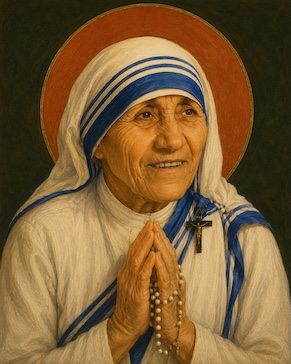
Mother Teresa (1910–1997)
Born Anjezë Gonxhe Bojaxhiu in what is now North Macedonia, Teresa joined the Sisters of Loreto and taught for nearly two decades in Calcutta before experiencing what she described as a call within her calling: to leave the convent and live among “the poorest of the poor” directly, on the streets where they actually were. She founded the Missionaries of Charity in 1950, building homes for the dying, the destitute, and the abandoned across Calcutta and eventually the world, on the theological conviction that Christ himself was present, disguised, in “the distressing disguise of the poor.” She became one of the most globally recognised faces of Christian charity of the twentieth century, awarded the Nobel Peace Prize in 1979. Her legacy is not without serious and documented criticism — questions about the standard of medical care in her homes, and her rigid public opposition to contraception and abortion even in contexts of extreme poverty and suffering, have been raised by credible critics and deserve to be taken seriously rather than waved away. We honour her radical, embodied insistence on Christ’s presence among the dying without pretending her practice was beyond all critique.

Desmond Tutu (1931–2021)
Archbishop Desmond Tutu was the most consistent moral voice raised against apartheid from within South Africa’s own churches, insisting for decades, from the pulpit and in every public forum available to him, on the non-negotiable dignity of every person made in the image of God and on God’s own preferential concern for the poor and oppressed. As Archbishop of Cape Town he risked his position and his safety to name apartheid as the theological heresy it was, at a time when large parts of white South African Christianity had made an uneasy peace with it. After apartheid’s end, he chaired the Truth and Reconciliation Commission, applying a theology of restorative rather than retributive justice to a deeply wounded nation — a model of leadership that tried to hold accountability and mercy together rather than choosing between them. Small in stature, quick to both laughter and tears, he embodied a Christianity that was unmistakably African, unmistakably Anglican, and fully free, and he was an early, unwavering advocate for LGBTQ dignity within a church that has often struggled to be either.
Indigenous leaders who have shown us all the way of Jesus
Ellen & Edwin Atkinson (1894–1965 / 1888–1952)
See their fuller entry in the previous section, but worth adding here that what made the Atkinson’s distinctively Indigenous leadership, rather than leadership that merely happened to be Aboriginal, is that neither Christianity nor political resistance arrived at Cummeragunja from outside their community — Eddy became pastor of a congregation that was already there, and the walk-off they joined in 1939 was organised, led, and sustained entirely by Aboriginal people themselves. They show the way of Jesus by showing that Aboriginal communities were never waiting for someone else’s leadership to arrive.
David Unaipon (1872–1967)
A Ngarrindjeri man from Point McLeay Mission (now Raukkan) in South Australia, see the fuller entry in the previous section. His particular gift to this category was refusing to let white Australia treat Aboriginal intellect and Aboriginal faith as a contradiction. He preached the gospel and patented inventions in the same breath, and insisted, in his own words in the preface to his best-known book, on being not the last but merely the first Aboriginal person to leave “an enduring record of our customs, beliefs and imaginings” — leadership understood as the opening of a door for others to follow through, not a monument to himself.
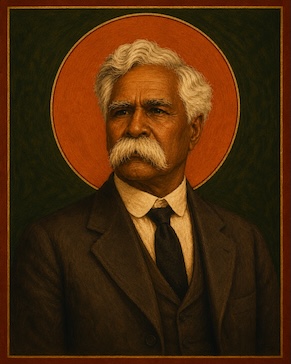
William Cooper (1860/61–1941)
A Yorta Yorta man born near the junction of the Murray and Goulburn rivers, Cooper spent much of his working life as a shearer and labourer before becoming, in his seventies, one of the most consequential Aboriginal political leaders Australia has produced. In 1933 he founded the Australian Aborigines’ League and drafted a petition to King George VI calling for Aboriginal political representation in federal parliament and an end to what he named plainly as the threatened “extinction of the Aboriginal race.” His most striking act of leadership, though, looked outward rather than inward: on 6 December 1938, weeks after Kristallnacht, the 77-year-old Cooper led a delegation on a ten-kilometre walk across Melbourne to the German Consulate to deliver a formal protest against the Nazi persecution of Jewish people — a gesture now recognised as the only such protest lodged anywhere in the world at the time, made by a man who had no rights of his own to spare and gave his solidarity anyway. “We as Aborigines have known persecution,” he said, “and we sympathise with all people who are oppressed.” Germany formally apologised for refusing his petition in 2020, seventy-nine years after his death.
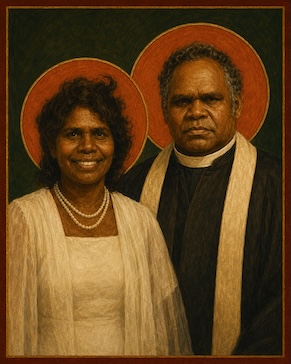
Don & Aileen Brady (1927–1984 / dates uncertain)
Don Brady, a Kuku Yalanji man raised on the Palm Island Aboriginal Settlement in Queensland, trained as a missionary and became a Methodist pastor working among Brisbane’s Aboriginal community from the 1960s, alongside his wife Aileen, a Kullilli woman. He is remembered, alongside a handful of contemporaries, as one of the pioneers of a genuinely Aboriginal Christian theology — insisting, against a century of mission practice that had positioned white missionaries as the necessary gatekeepers to God, that Aboriginal people had their own direct, unmediated relationship with Christ, grounded in their own culture and their own long relationship with this land, rather than one that needed to pass through white hands first. He became the first Aboriginal church leader to lead political marches, helped found Aboriginal legal aid, housing, and medical services in Queensland, and refused to separate the gospel he preached from the justice he demanded. Their example insists that Aboriginal theology was never a later addition to Christianity in this country, grafted on from outside, but something Aboriginal Christians worked out for themselves, on their own authority, from the beginning.
Doug & Gladys Nicholls (1906–1988 / 1906–1981)
See their fuller entry at the end of the first group above. Here it’s worth naming plainly what that entry implies but doesn’t spell out: an Aboriginal-led church, an Aboriginal-led welfare network, and Aboriginal-led advocacy that reached all the way to Government House were not achievements granted to Doug and Gladys Nicholls by a sympathetic white church. They built all of it themselves, from a Fitzroy chapel outward.
MumShirl Smith (c.1921–1998)
See her fuller entry in “those who taught us to unite the quest for justice with the life of prayer,” above. Her ministry belongs here too because almost every one of the institutions she helped found — the Aboriginal Legal Service, the Aboriginal Medical Service, the Aboriginal Housing Company — was built on the same conviction Cooper, the Bradys, and the Nichollses all shared: that Aboriginal people did not need white institutions to care for Aboriginal people; they needed the resources and the standing to care for each other, which is a different thing entirely, and worth building from scratch if it didn’t yet exist.
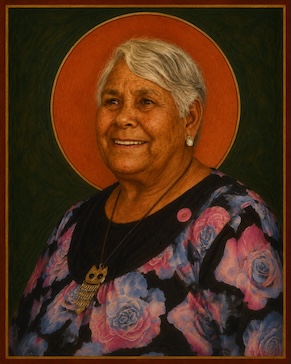
Lowitja O’Donoghue (1932–2024)
Taken from her mother at the age of two under the same government policies that would come to be known, decades later, as the Stolen Generations, Lowitja O’Donoghue was raised in a mission home, renamed, and did not see her mother again for over thirty years. She became the first Aboriginal person to train as a nurse at the Royal Adelaide Hospital in 1954, having had to campaign for the right to enter the profession at all, and went on to become the first woman to head a federal government department and, in 1990, the founding chairperson of the Aboriginal and Torres Strait Islander Commission (ATSIC) — the first genuinely national body of Aboriginal political representation Australia had ever had. She led the negotiation of the Native Title Act following the Mabo decision, was the first Aboriginal person ever to address the United Nations General Assembly, and was personally consulted by Prime Minister Kevin Rudd in preparing the 2008 national Apology to the Stolen Generations — advising, that is, on a formal apology for precisely the kind of removal that had shaped her own childhood. Her faith was, in its own way, as complicated as her life: raised within the Baptist mission system from early childhood — the very apparatus that had taken her from her mother — she nonetheless remained a devout and lifelong Baptist, later working as a nurse with the Baptist Overseas Mission in Assam, India, and worshipping at a Baptist church in Adelaide until her death. She never let that faith excuse the churches’ role in her own removal; in later years she said so plainly, and pushed the churches that had shaped her toward the same honest reckoning she asked of the nation. That she could hold her faith and her critique of the church together, without collapsing either into the other, may be its own kind of leadership. She died in February 2024, having spent sixty years turning the specific wound of her own removal into a lifetime of institution-building for the people who had shared it.